

The weekly read on where institutional credit meets the wealth channel.
AT A GLANCE
EDITOR’S NOTE
One of the stranger features of modern finance is that the people creating the products and the people eventually owning them often inhabit completely different worlds. The structurer in Canary Wharf and the saver in Solihull are, in a technical sense, business partners. They’ve almost certainly never met.
A private credit fund originates a loan. An arranger structures it. A bank packages it. A platform distributes it. A wealth manager recommends it. Eventually it finds its way into a portfolio belonging to a pension saver, a family office, or a private banking client. By the time that happens, the journey can be remarkably difficult to follow, even for the people doing the engineering. We’ve made a small career out of it and still occasionally have to draw diagrams.
Most financial publications cover a particular bit of the chain. The private credit press covers private credit. Structured finance publications cover securitisation. Wealth management publications cover advisers, platforms and portfolios. Each does its job admirably.

So that’s where we’ll spend our time. Each week we’ll take a single development – a transaction, a regulatory shift, a market trend, or an early warning that something somewhere isn’t quite right – and look at what it means at both ends of that journey. We call this the Crossover, and it’s what the newsletter is built around. Alongside it, we’ll keep an eye on the deals, the structures, and the vehicles being used to move credit from one world to the other.
You already know what The Structured Scoop is, and you know who writes it. What’s new is the focus. We’ve spent the last eighteen months explaining how individual structures work; we’re now going to spend our time on what happens when those structures meet the people who end up holding them.
The writing assumes you’re intelligent. It doesn’t assume you’ve spent twenty years inside a structuring desk, a law firm, or an investment bank – though if you have, you’ll recognise most of what we describe. Where something needs explaining, we’ll explain it.
Some of the most important developments in finance happen long before they reach an investor’s portfolio. The interesting question, and the one nobody’s quite getting round to answering, is how they get there.
Alper Deniz
Founder & Editor

Three developments from the last fortnight, taken together, offer a useful glimpse into how institutional credit is finding its way into private wealth.
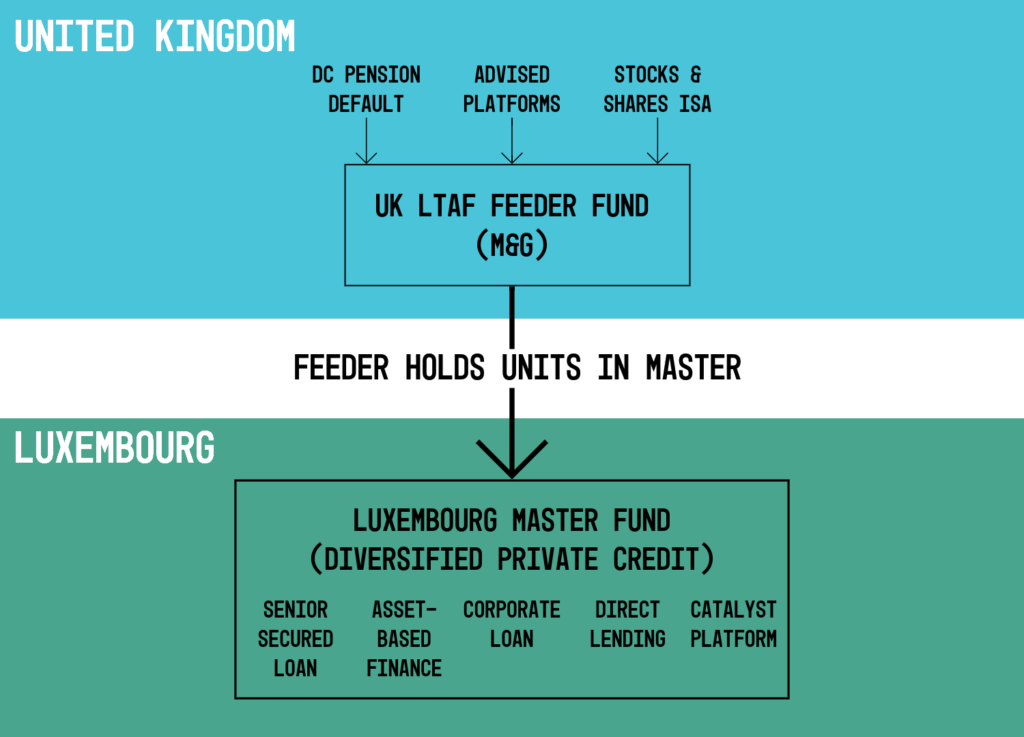
The first is in the UK. M&G has been authorised by the FCA to sell its Diversified Private Credit Feeder LTAF to pensions, advised platforms and ISA holders. The mechanics are worth setting out, because the same structure is going to keep turning up.

M&G’s version is a UK fund that holds units in a larger Luxembourg fund, and it is the Luxembourg fund that holds the actual loans. The UK shell is the bit the rules allow to be sold to British savers. The Luxembourg side is where the diversification occurs.
The M&G fund is now for defined-contribution pension default arrangements, for advised platforms, and, since April this year, for stocks and shares ISAs. A default arrangement is the investment option a DC scheme places members in when they do not actively choose anything else, which is most members. M&G joins Apollo, BlackRock, Hamilton Lane, Schroders Capital and several others already on the same list of fund providers. In about eighteen months the UK has gone from talking about retail private credit to actually selling it.
The second is on the other side of the Channel and looks quite different. BNP Paribas filed a supplement to its Euro Medium Term Note programme this week for a new series of credit-linked notes. The notes reference iTraxx Europe Main, the standard European investment-grade credit index.
The payoff is simple. The investor puts in a hundred today and gets a hundred back at maturity – that is the capital guarantee. Along the way, the investor receives a coupon, the size of which depends on how iTraxx Main has performed.
This kind of structure was effectively dead in the years that European rates sat near zero, because there was no carry available to fund the principal guarantee. With rates where they are now, the maths works again. Société Générale’s 2026 structured products outlook calls structures of this kind one of the defining product categories of the year. Distribution is through BNP’s own private bank network and selected European wholesale partners.
The third comes from America, and the headline number is one to pay attention to. McKinsey’s Global Private Markets Report, published on 9th June, found that redemption requests at non-traded US business development companies ran at about 16% of NAV in the first quarter of this year. A BDC, in this context, is the older semi-liquid wrapper through which a great many American wealth investors first met private credit.
That 16% is more than three times the 4.5% figure for the previous quarter, and well above the 5% quarterly cap managers are legally entitled to enforce. Five BDCs hit the cap in the fourth quarter of last year. The wrapper performed exactly as designed: nobody was forced to sell loans into a falling m

An LTAF, a Credit-Linked Note, and the Credit Sitting Behind Them Both
Two products that look different but aren’t
The M&G LTAF and the BNP Paribas credit-linked note look, at first glance, like products with very little to do with each other. One is a fund; the other a debt instrument issued off a bank’s medium-term note programme. One is sold by independent financial advisers to pension savers and ISA holders. The other is sold by private bankers to wealthy clients over coffee.
They live in different parts of any given bank’s organisation chart, they sit on different shelves in different bits of the trade press, and they get analysed by different people. None of which, on inspection, is an interesting fact. The interesting fact is what’s behind them, which is the same thing.
The credit risk a wealth investor takes when buying the LTAF – the chance that some company somewhere fails to pay back the loans inside the fund – isn’t unrelated to the credit risk the credit-linked note investor takes. The borrowers overlap
THE PRODUCT JOURNEY

The private credit manager whose loans sit inside the LTAF feeder is, somewhere on its balance sheet, hedging or laying off portions of that same credit exposure into the significant risk transfer market. Significant risk transfer, or SRT, is the regulatory tool that lets a bank transfer the credit risk of a loan portfolio to a third party while keeping the loans on its own books. It’s how banks free up regulatory capital without actually selling anything.
The same iTraxx Main index that sits behind the BNP Paribas note is being referenced right now by SRT trades that UK clearing banks are doing under PRA PS1/26, the Bank of England’s most recent capital rules. Different wrappers, different distribution channels, one shared pool of credit risk underneath.
The bit nobody’s writing about: manager concentration
Large-scale private credit isn’t, on close inspection, a particularly large industry. Five names – Apollo, Blackstone, Ares, KKR, Goldman Sachs Alternatives – together with a smaller tail of perhaps another fifteen, do most of the heavy lifting.
Those five are doing two different things at the same time. They’re originating the loans that end up inside the LTAFs and ELTIFs now being authorised across the UK and Europe. They’re also, directly or indirectly, behind the reference portfolios and warehouse positions that banks use to manufacture credit-linked notes for private bank clients.
The consequence is worth saying plainly. A diligent wealth allocator who buys the M&G LTAF for the pension portfolio and a credit-linked note referencing iTraxx Main for the high-net-worth book, and who is rather pleased with themself for diversifying across two quite different product types, may in fact have doubled their exposure to the same three or four manager balance sheets.
The wrapper diversification is real. The manager diversification, in plenty of cases, isn’t.
The 16% NAV redemption number from the US BDCs is the third signal pointing in the same direction – and probably the one that matters most for what happens next.
Notice what the number is and what it isn’t. It isn’t a wrapper failure. The BDC structure performed precisely as designed: it gated, the 5% quarterly cap held the line, and the manager was protected from having to dump private loans into a falling market at distressed prices.
What didn’t hold was something else. The technical term is the liability profile of the fund. What it means, in practice, is the speed at which investors are entitled to ask for their money back, measured against the speed at which the manager can realistically hand it over. Wealth money can ask for its money back fast. Private credit, by its nature, can only be turned back into cash slowly. When those two speeds part company, the manager can’t meet every redemption request in full. Investors are paid a portion of payout and have to queue for the rest. For most of them, it’s the moment the illiquidity of what they own stops being theoretical.
That matters here because both products in the news brief embed their own assumptions about liability profile. The M&G LTAF allows quarterly redemption with notice and gives the manager a 30% NAV borrowing cap to play with. The manager can borrow against the fund up to 30% of its value to manufacture short-term cash when redemption requests come in.
The BNP Paribas credit-linked note goes the other way. Principal protection comes at maturity and there’s no early exit. Which is, on reflection, the simplest possible liability profile, and the reason the note wrapper is structurally tougher than the open-ended fund wrapper when the market turns.
America has just run the first live test of wealth-channel private credit liability profiles. The UK and Europe are calibrating against the result in real time, whether or not anyone’s saying so out loud.
What it adds up to commercially
The credit cycle will turn, as credit cycles do. When it does, the correlation between fund-wrapper credit products and note-wrapper credit products will be higher than the wrapper differences appear to suggest. The underlying credit overlaps. The underlying managers overlap more than wealth allocators have understood.
Why both products exist in the first place
Both products are responses to the same demand. Wealth money and DC pension money want more credit exposure than they used to. Interest rates are higher than they used to be, and the kind of bond yield available inside a regulated fund is finally worth having again. The numbers are large.
Wellington Management’s 2026 private credit outlook suggests US retail allocation to private credit could grow from about $0.1 trillion today to roughly $2.4 trillion by 2030. That’s the kind of forecast worth treating with a certain degree of professional scepticism, but not worth dismissing, because the direction of travel is unambiguous. KPMG counted 252 ELTIF funds across Europe at the end of 2025, with private debt the dominant strategy at 35% of launches. BlackRock’s Private Markets Outlook names wealth investors reaching private markets through ELTIFs, LTAFs and model portfolios as the single defining theme of the year.
The same demand pulls on both wrappers; the structuring desk and the distribution desk simply choose differently. Which wrapper sits in which jurisdiction, and at what stage of build-out, is the picture in this week’s Chart of the Week below.

M&G Diversified Private Credit Feeder LTAF – the UK Rolls Out the Chassis
This week’s deal is the clearest illustration yet of the way the UK’s solving its wrapper question. It’s worth taking the time to look at it properly.
The manager is M&G plc, through M&G Investments. M&G is one of the larger active asset managers in the UK, with about £346 billion under management at the end of 2025, and runs a long-established private credit franchise through its Catalyst and direct lending platforms. This isn’t a firm encountering the asset class for the first time.
The vehicle is an open-ended Long-Term Asset Fund, authorised under COLL 15, which is the section of the FCA’s rulebook that governs LTAFs. It’s set up as a feeder into a Luxembourg-domiciled master fund, where the actual private credit portfolio sits. Investors can subscribe monthly. They can redeem quarterly, after giving notice. Borrowing is capped at 30% of NAV, the FCA’s standard LTAF leverage limit. The fund can be bought by DC pension default arrangements, by advised retail platforms and, since April, by Stocks and Shares ISA holders.
The mandate is diversified UK and European private credit. Senior secured corporate lending, along with some asset-based finance. The reason for the feeder-into-Luxembourg-master arrangement, rather than M&G simply running the loans directly from a UK-domiciled fund, is one of the more interesting structural decisions in the deal.
Three things in the structure stand out.
The feeder-into-Luxembourg-master plumbing
A UK LTAF is allowed to hold private credit positions directly. M&G chose not to. The reason is scale.
A standalone UK-domiciled private credit fund launching today would have to build its portfolio from a standing start. It would need to source loans, perform due diligence, get them onto the books and accumulate enough diversification across borrowers and sectors to look like a credible product rather than a concentrated bet. That takes a few years. Wealth distributors don’t want a fund that needs three years to build up. They want something they can begin allocating for the next quarter.
The feeder structure resolves both halves of the problem in one stroke. M&G already runs a large, diversified, operationally established Luxembourg fund holding the kind of UK and European private credit the LTAF wants exposure to. By making the UK LTAF a feeder into that existing engine, the LTAF launches with the diversification and the scale already in place. The UK shell is left to do nothing more than be the compliant wrapper for selling to pensions and ISAs.
Whether this becomes the standard pattern for UK LTAF launches, or whether managers begin to launch UK-domiciled portfolios directly as the market matures, is a genuinely open question. The next four or five authorisations will probably tell us.
The FCA capped LTAF borrowing at 30% of NAV. ELTIF 2.0 in Europe is more permissive. The distinction becomes important because of how managers meet redemption requests in an open-ended fund holding illiquid assets.

The NAV facility market is currently busy. Around 80% of participants in a recent survey expect volumes to grow in 2026. The FCA’s 30% cap means UK LTAFs have a smaller borrowing envelope to work with than their European counterparts, and NAV facility documentation calibrated specifically for LTAF compliance is likely to appear over the next twelve months. It’s plumbing rather than glamour, but it’s also the kind of plumbing that determines whether an open-ended fund can actually pay redemptions back when the credit cycle finally tests it.
The ISA change, which is more important than it looks
The decision in April this year to make LTAF units eligible for the Stocks and Shares ISA wrapper sounds technical and is actually transformational. Roughly 12 million UK adults hold a Stocks and Shares ISA, and the average balance is around £29,000. Even a modest level of LTAF penetration into that pool produces an absolute pound figure that’s genuinely large.

The flip side is regulatory. The FCA’s Consumer Duty is the obligation on firms to deliver good outcomes for retail customers. The Consumer Composite Investments regime, which went live on 6th April this year, is the new UK disclosure framework for retail investment products and has now largely replaced the old PRIIPs regime. Any distributor putting LTAF units into an ISA wrapper should expect FCA supervisory interest as the channel grows. Marketing materials are going to be tested against the new disclosure rules rather than the old ones.

The UK LTAF goes from “available” to “actually used”
A short refresher first, for any reader new to the UK regime. The Long-Term Asset Fund, or LTAF, is a UK fund structure the FCA introduced in 2021 to let pension schemes and retail wealth platforms hold illiquid alternatives – private equity, private credit, infrastructure, real estate – inside a properly regulated wrapper. It’s the UK’s answer to the same question Europe answered with ELTIF 2.0 and the US answered with the interval fund: how do you give ordinary investors access to slow-money assets without the daily-dealing structure causing a problem the first time a meaningful number of them want out?
A second refresher, because the next sentence uses the phrase repeatedly and it baffles most readers outside the pensions world. A defined-contribution, or DC, pension is the standard modern UK workplace pension. The employee pays in. The employer pays in. The money is invested, and what comes out the other end depends on how the investments have performed.
Almost everyone in such a scheme stays in the default arrangement, which is the investment option the scheme’s trustees have chosen for members who don’t actively pick anything else. Trustees aren’t allowed to charge much for it – there’s a statutory charge cap – and they carry specific legal duties around how it’s run.
LTAF eligibility for DC defaults matters because it allows trustees to put private-markets exposure inside the default arrangement itself, rather than only in a self-select side menu that hardly anyone uses. UK DC assets stood at over £700 billion at the end of last year, and the figure is growing.
To the watch list itself. The LTAF has shifted decisively in 2026 from “available but underused” to “actively used at scale”. Four developments from the past four months illustrate that change.
QUOTE OF THE WEEK

– McKinsey, Private Credit Market Enters a New Phase, 9th June 2026
McKinsey’s report is anchored in the US, but the underlying point is equally relevant here. The point worth pulling out of it is that wealth and insurance money aren’t simply additional pots of capital sitting alongside the old institutional ones. They change what kind of manager a private credit firm must be.
The liability profile of a non-traded BDC manager today resembles that of an insurer more than that of a private equity fund. The liability profile of a UK LTAF manager resembles that of a DC scheme more than that of a Cayman LP. The liability profile of an ELTIF 2.0 manager running quarterly liquidity gates resembles that of an open-ended UCITS fund more than that of a closed-end private credit vehicle.
Deployment cadence – how fast money can be put to work and how fast it can be given back – has become the question the structuring decision has to answer. The skills the role requires have changed. Not every manager has them.


The chart tells the story across the rows without any commentary being necessary: the same underlying structured credit reaching wealth investors through four jurisdictionally distinct wrapper channels, with each jurisdiction at a different stage of build-out. The next twenty-four months will be about which wrappers scale fastest, which break first under stress, and which managers manage to build distribution across more than one of them.

And finally…
Ledgers & Loose Ends: The Glastonbury Fallow Year, and the Strange Discipline of Switching Off
Worthy Farm is quiet this week. 2026 is a fallow year, the every-five-or-six-year pause Michael and Emily Eavis build into the calendar to let the land recover from being trampled by 210,000 people and rather more portable loos than anyone wants to think about. The cows are back. The pyramid is dark. No one is buying overpriced cider.
From a finance perspective, the fallow year is more interesting than the festival itself. Glastonbury is, in the round, a roughly £80–100 million annual operation. The Eavis family takes the conscious decision, every few years, to turn the revenue line off for twelve months while keeping the cost base broadly intact. Core staff stay on. Sponsor relationships have to be nursed. Suppliers, who depend on the festival in the way only a long-standing partner can, need keeping warm. The reserves built up during festival years have to be planned to cover precisely this gap.
It is, in effect, a deliberate liability-profile mismatch – revenue paused, obligations continuing – and it works because the operator has the cash discipline to fund the pause without panicking. Which is, more or less, the whole point of this week’s newsletter, applied to a different industry.
Glastonbury comes back in 2027. The cows, presumably, will be informed in due course.
That’s Issue #1 of the new Structured Scoop. Thank you for reading it. We would genuinely like to hear what worked and what didn’t – the newsletter gets better when readers tell us where it isn’t quite there yet. Back next week.
The Structured Scoop is published independently from any other organisation. All editorial decisions are made independently and The Structured Scoop has no commercial relationship with any other organisation.