

The weekly read on where institutional credit meets the wealth channel.
AT A GLANCE
EDITOR’S NOTE
The wrapper we spend most of our time on in these pages is a fund. This issue we look at a slightly different one: the bank balance sheet itself.
Bawag is not a household name outside Austria. It should probably be a bit more of one. The bank has spent the past year doing something that would have been unthinkable a decade ago – using a Significant Risk Transfer on its own credit-card loans to buy itself the regulatory capital headroom to make a €1.62 billion cross-border acquisition. Shareholders vote on the deal next Wednesday. Glass Lewis has come out against it. The story we care about is not really the vote. It is that a mid-sized European bank has quite openly used the SRT market to fund M&A, and nobody is treating that as remarkable.
Around that central item we have Klarna doing something rather different with the same instrument, a new set of numbers from the IACPM that tells us how big all of this has become, and a Ledgers piece on where the darts prize money is coming from that turns out – not for the first time in this newsletter – to be a story about broadcast rights and a scalable, cash-generative asset. This is a lighter July issue. Wrapper Watch is on holiday until September.
Alper Deniz
Founder & Editor

Three things from the week to 23rd July.
Bawag books its capital, tees up the vote. Bawag’s extraordinary general meeting is on Wednesday 30th July. Shareholders are being asked to approve a €1.62 billion acquisition of Ireland’s Permanent TSB – a deal that would give the Austrian bank a scaled retail-and-mortgage platform in a market it does not currently operate in. Glass Lewis, in advice published earlier this month, is urging investors to reject the deal on price and strategic-fit grounds.

The bank’s chief executive spent last week telling anyone who would listen that Bawag has more than €1 billion of excess capital, most of it built up by refusing to distribute dividends and by writing a Significant Risk Transfer on its credit-card loan book. Whether or not the deal goes through, the point is worth pausing on. Bawag used an SRT to buy itself the capital headroom to make an acquisition. That is a use case for the instrument nobody was really writing about two years ago. Irish Times
Klarna prints its second repeat-investor SRT. On Wednesday 16th July, Klarna announced it had completed a $518 million SRT with a returning institutional investor – the second such trade the two have done together. The deal frees up capital to support around $12 billion of additional lending on the Swedish bank’s consumer books. Klarna’s CFO said in the release that “an existing investor returning for a second securitisation is a real vote of confidence in the quality of our underwriting.” That is corporate-speak, but it is also, in the private-credit world, how relationships turn into programmes. We look at the mechanics in Deal of the Week below.
IACPM prints the 2025 numbers. The International Association of Credit Portfolio Managers published its annual SRT survey in June. Participating banks securitised €378 billion of loans in 2025 and protected €30 billion of junior tranches, increases of 35% and 21% respectively on 2024. That gives us hard numbers on a market this newsletter has covered on and off for a year. The 2025 pool is bigger than the 2024 pool, and it is broader too: with digital-infrastructure, project-finance and consumer-BNPL exposures all now sitting in the mix alongside the SME and corporate books the market grew up around. PitchBook has a good read on how different European banks are using the tool.

One instrument, three different books, one wealth-channel buyer.
The story we keep coming back to in this newsletter is that instruments which used to live in specific corners of the market have become general-purpose tools. The Significant Risk Transfer is the current example. Three trades this year make the point.

BBVA used an SRT earlier in the year to transfer credit risk on €2 billion of infrastructure loans – a long-dated, concentrated pool of exposures to a handful of hyperscaler-driven data-centre projects. Klarna last week used an SRT to transfer risk on a portfolio of very short-dated, very granular unsecured consumer receivables. Bawag has spent the past twelve months using an SRT on its credit-card loan book to build up capital for an acquisition. Three completely different credit stories. The same instrument in all three cases.
The buyers are worth thinking about too. The counterparty on a European SRT trade is typically a specialist credit fund – Chorus Capital, D. E. Shaw, Christofferson Robb, Magnetar and a growing cohort of newer entrants – many of which are, in turn, distributed to wealth clients through interval funds, long-term asset funds (LTAFs) and European long-term investment funds (ELTIFs). We have written before about how the wealth channel is becoming a meaningful source of demand for private-credit product. What we have not spelled out until now is that the wealth channel is, at one remove, also a source of demand for European bank capital relief. The same wealth-adviser who allocates a client to an interval fund is helping fund the junior tranche on a Bawag credit-card SRT.
It is how a large chunk of the European banking system is now funded. It is worth understanding.

Klarna’s $518 million SRT – buy now, transfer credit risk later.
On Wednesday 16th July, Klarna announced it had completed a $518 million Significant Risk Transfer with a returning institutional investor. The deal frees up capital to support around $12 billion of additional lending on Klarna’s consumer books and forms part of a wider capital-efficiency programme that also uses forward-flow arrangements and warehouse financing.
Three things about the trade are worth pausing on.
Klarna is not a bank in the way BBVA is a bank, but it is treating itself like one. Klarna is a licensed Swedish bank – it has held a full banking licence since 2017 – but the balance sheet is built around short-duration consumer receivables, mostly from its buy-now-pay-later product. That is a very different loan book from the corporate and infrastructure exposures the SRT market grew up around. The instrument, however, is the same. Klarna keeps the receivables on its balance sheet and continues to service them; a private investor sells credit protection on a defined slice of the pool in exchange for a premium; Klarna gets to reduce the risk-weighted assets it carries against that pool and, therefore, the regulatory capital it has to hold.

The buyer is a repeat. Klarna and its counterparty have now done two of these together. Repeat SRT trades are the market’s version of a vote of confidence. They also compress spreads, because a returning investor already understands the underwriting file, the servicing infrastructure and the loss history. Klarna’s CFO said in the announcement that the returning investor was “a real vote of confidence in the quality of our underwriting.” That is corporate-speak, but it is also, in the private-credit world, how relationships turn into programmes.
The wrapper theme. European banks are turning to SRT more and more to reshape balance sheets that used to be reshaped, if at all, by selling loans outright or by raising equity. Selling loans breaks the customer relationship. Raising equity dilutes shareholders. SRT does neither. Klarna, BBVA and Bawag have all arrived at the same tool for the same reason: preserve the customer relationship, keep servicing the book, sell the risk. The buyers are, in every case, the same kinds of funds that show up as investors in every corner of this newsletter. Klarna’s release


– Kevin Warsh, Chair of the Federal Reserve, in testimony to the House Financial Services Committee, 14th July 2026. The line landed as GENIUS Act stablecoin rules start coming into force in the US, and reads pretty neatly alongside the MiCA regime already in place on this side of the Atlantic. Both major stablecoin regimes have now arrived at the same place: authorisation, reserve rules, redemption rights, supervisory oversight – and, on both sides of the Atlantic, no lender of last resort standing behind the wrapper.

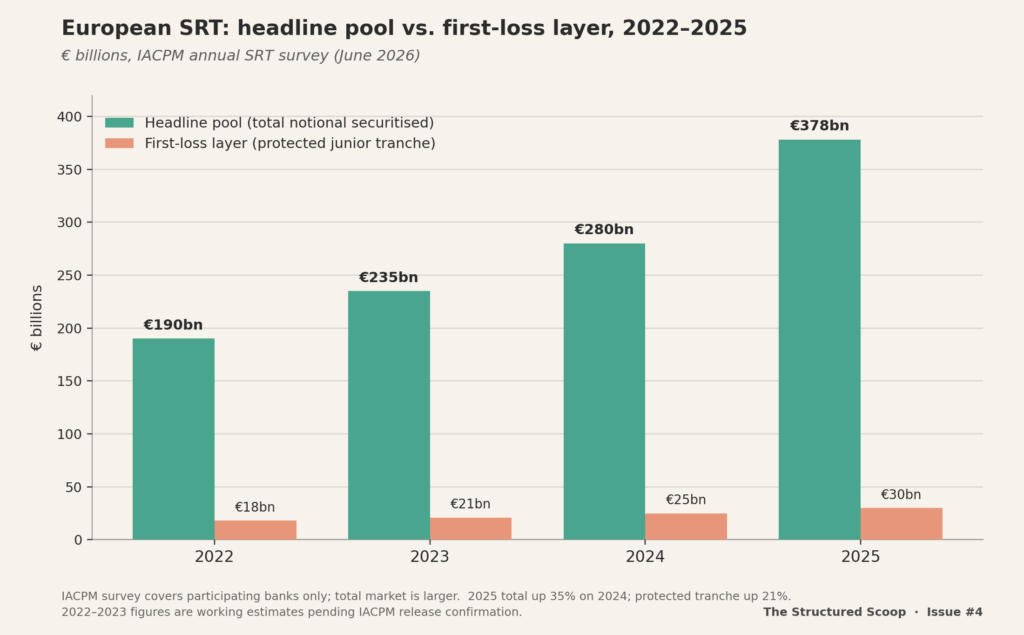
The chart shows two data series that most readers will not have seen side by side, so it is worth explaining what each one is and why we have plotted them together.
The green bars – total notional securitised. This is the headline number the market usually quotes. It is the total pool of loans on which participating European banks bought credit protection through SRT in each year. In 2025, that pool reached €378 billion. It is a useful measure of how much loan volume the instrument is now touching, and it is what most industry reporting focuses on.
The salmon bars – protected junior tranche. This is the smaller and more important number. When a bank buys credit protection through an SRT, it does not sell risk on the whole loan pool. It sells risk on a specific slice of that pool – typically the “junior” or “first-loss” tranche, which is the bit that takes the initial hit if borrowers stop paying.

That first-loss slice is where a private-credit fund actually deploys money. It is the layer that carries the yield. And it is the layer whose size determines how much capital relief the bank actually receives, because banks hold the most regulatory capital against the riskiest slice of a loan pool.
Why we plot them together. Reading the two series side by side tells you two things you cannot see from either one alone. First, ratio: in 2025 the junior tranche was roughly 8% of the total pool. That ratio has been remarkably stable across the four years – in a market that has grown its overall notional by nearly a factor of two, the amount of first-loss risk buyers are asked to take on has stayed proportionate. Second, absolute size: €30 billion of junior-tranche risk is the number to hold in mind. That is the size of the credit-fund industry’s actual 2025 allocation to European bank first-loss risk. It is also, in rough terms, the amount of European bank regulatory capital that came out of the balance sheet through the SRT market last year.
The instrument, in other words, has scaled without meaningfully changing shape. That is a more useful fact about the market than the €378 billion headline on its own.
Sources: IACPM annual SRT survey (June 2026); 2022–2023 figures are working estimates pending confirmation from the earlier releases.
And finally…

Where the darts money is coming from.
The Betfred World Matchplay is into the quarter-finals tonight at Blackpool’s Winter Gardens. Luke Littler is defending. The prize fund is £1 million – up 25% on 2025, with a £225,000 cheque waiting for the winner. Which is, in itself, unremarkable, until you look at what has happened to the rest of the PDC’s calendar.
Total prize money across the professional darts circuit has risen from £18 million in 2025 to £25 million in 2026, a £7 million uplift the PDC announced in March last year. That is a bigger annual jump than the entire prize pool for the Betfred World Matchplay itself. The Premier League, the Grand Slam, the World Championship and a set of Players Championship events have all seen material increases. A first-round loser at Blackpool takes home £12,500 – more than a Champions Tour golfer earned for making the cut at some events a decade ago.
Where does that money come from? Some of it comes from betting sponsorship – Betfred is the title sponsor of the Matchplay, Ladbrokes runs the Masters, Boyle Sports has the Grand Slam. But the more interesting share comes from broadcast rights. Sky Sports pays for the UK; DAZN pays for the German-speaking market, where darts has become genuinely large; ESPN pays for the US, where it has not yet but is on the way; L’Équipe pays for France. The PDC has, over roughly a decade, turned a Blackpool ballroom pastime into a set of international broadcast contracts denominated in four currencies. That is closer to the Formula 1 revenue model than to any traditional British sporting body. And it is, in miniature, the same story we tell in every issue of this newsletter. Something that used to be niche and privately owned has turned, without much fanfare, into a scalable, cash-generative asset with a wealth-channel-adjacent buyer base. Just with sequins. Whether Littler retains, we will find out on Sunday.
That’s Issue #4 of the Structured Scoop. Thanks for spending part of your week with us. If something made you think, taught you something new or missed the mark entirely, we would love to hear about it. We will see you in the next issue.